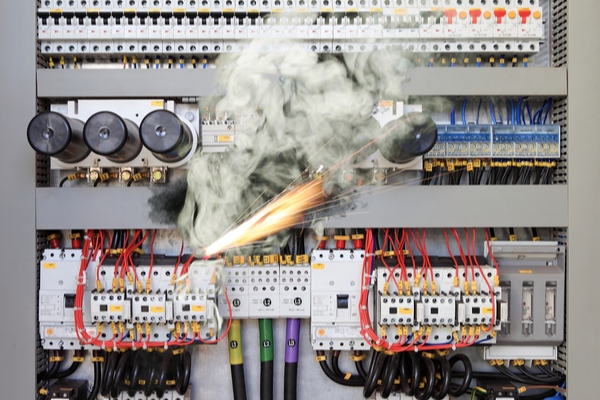
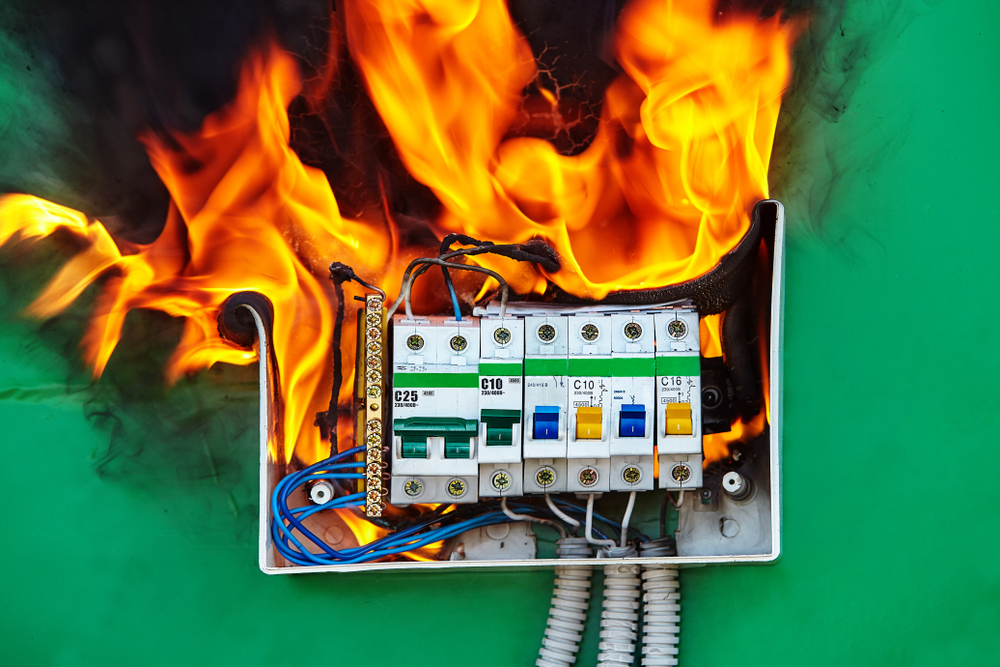
Simulacro de Accidente por Riesgo Eléctrico en Tablero de Distribución .
Un componente eléctrico mal ejecutado en un Tablero de Distribución en un tablero fuera de norma puede generar un incidente que una aseguradora o demanda no podrá cubrir. Una normalización eléctrica permite detectar a tiempo este tipo de sobrecargas, con un diagnóstico eléctrico cuidadoso.
Electrical Standardization and Regulatory Compliance
Electrical Standardization of Installations
In legal terms, an installation that does not comply with applicable standards is an unsafe installation.
This applies in the context of Insurance Companies, Courts of Justice, Government Inspections, and Public Authorities.
In the event of any type of incident, occupational accident with or without lost time, failure involving users, legal claims, regulatory inspections, audits, or technical inspections, you are at a disadvantage.
If problems arise, you lose the case.
It only takes an expert witness performing a preliminary judicial inspection to leave you completely exposed, with no trusted professional in a position to effectively defend the installation.
In newly constructed installations, as well as installations that have been in service for some time, the mere fact that connected equipment operates successfully does not guarantee the absence of hidden defects that may eventually result in electrical incidents.
When such defects are suspected, your electrical system may require Electrical Standardization due to an actual Electrical Hazard, or, in more serious cases, complete Regulatory Compliance.
Current Chilean Regulations, validated by the National Standards Institute (INN), regulated by the Superintendency of Electricity and Fuels (SEC), and enforced by several other authorities, including the Regional Ministerial Secretariat (SEREMI) of the Ministry of Health (MINSAL), provide the legal and technical framework used to determine whether an electrical installation is safe.
Likewise, Chilean Regulations recognize the following standards as complementary technical references:
Remember that if your installation does not comply with applicable standards, you are at a disadvantage.
Moreover, if an incident occurs under such conditions, the Legal Representative may ultimately be required to answer before the law.
In addition, Insurance Companies may refuse coverage for an installation presenting deficiencies or hidden defects.
For substandard installations presenting one or more of the following conditions:
Have not undergone proper electrical maintenance,
Have been in operation for many years,
Have experienced electrical incidents,
Have a history of poor-quality repairs,
Present deficiencies in their original design,
Show evidence of improper or inefficient operating practices,
Omit critical safety components,
Electrical Hazard is a factor that may result in actual losses through any of the following accidents affecting users or installations:
Electrocution of Users due to Electric Shock,
Fire Hazard,
Internal Equipment Failures caused by Electric Arc.
In the best-case scenario, these accidents result only in material damage to the installation. In the worst-case scenario, they may result in a fatality.
Accident Simulation involving Electrical Hazard, resulting in Fire caused by Electric Arc inside a Low-Voltage Protection Box 2026-08-18 - Centra Ingenieros